
Dark Horse D&D Comic: Bridging Lore & Tabletop Play
Dark Horse's new Dungeons & Dragons comic offers a fresh narrative lens into Faerûn. We analyze how such stories can mechanically inspire GMs and players, enhancing campaigns beyond the page.
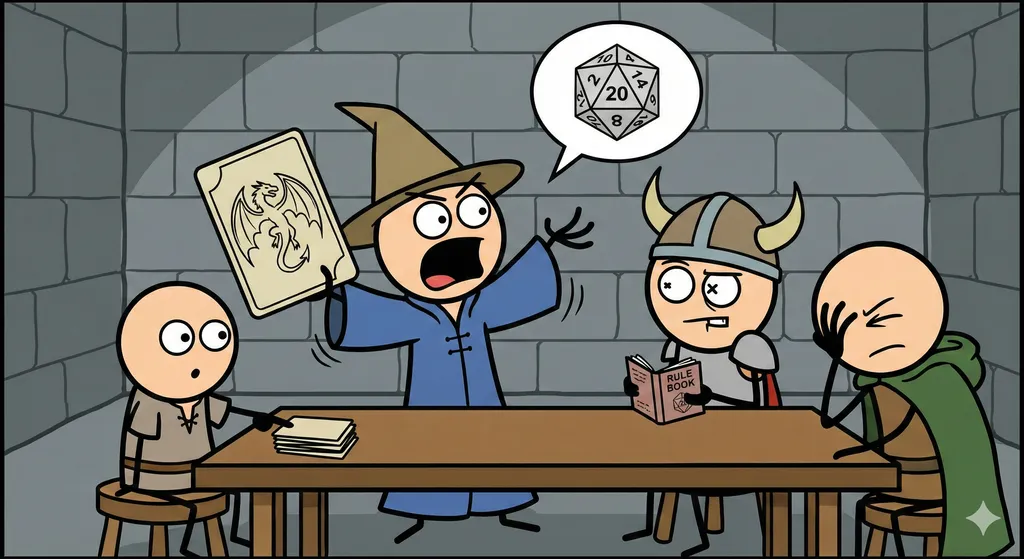
Dark Horse Comics' announcement of a new Dungeons & Dragons series has certainly piqued the interest of many a seasoned dungeon delver and lore aficionado. While the initial news from EN World focused on the mere existence of the title, our concern here at The Crit Sheet is less about the headline and more about the impact on our tables. We're not just reading comics; we're seeking tools to enrich our campaigns, to deepen the well of creativity for both Game Masters and players alike.
While a comic book doesn't come with stat blocks appended to its panels, its true mechanical value lies in its power as a wellspring of inspiration. Consider the introduction of a unique antagonist, perhaps a new type of aberration never before codified in the Monster Manual, or a particularly insidious trap mechanism that operates on principles unfamiliar to the standard 'detect magic' and 'disarm device' routine. A new Dungeons & Dragons comic could present a compelling narrative that demands the creation of custom rules for a specific magic item, not just a +1 sword, but an artifact with a deeply woven backstory and a suite of conditional abilities and drawbacks. This isn't about *reading* crunch; it's about *generating* it. A clever DM, observing a character in the comic utilize a familiar spell in an entirely new context – a 'Fog Cloud' not for concealment, but for conductive properties with a lightning bolt – immediately has a new tactical option to consider or present to their players. It's the spark for homebrew, for new subclasses, for environmental effects that truly challenge the known ruleset of 5th Edition.
Consider a new form of planar travel depicted: not merely a portal, but a harrowing journey through a 'liminal space' with unique hazards and sanity-draining effects. This isn't just a visual; it's a blueprint for a new chase sequence, a skill challenge, or even a mini-game that challenges player resources in a novel way. Or perhaps the comic introduces a unique social structure within a monster society – a hierarchy that dictates specific reactions, alliances, or vulnerabilities, transforming a simple combat encounter into a complex social puzzle with distinct mechanical outcomes based on player choices. The very act of a character in the comic making a difficult moral choice under specific magical duress could inspire a DM to craft a new 'corruption' or 'stress' mechanic for their own game, adding layers of consequence beyond hit points and saving throws. This is the true power of a narrative adjunct: it provides the *ideas* for the crunch, without dictating the numbers, allowing GMs to tailor the mechanical execution to their specific table and version of Dungeons & Dragons.
Beyond the raw potential for mechanical adaptation, the primary draw of any Dungeons & Dragons narrative extension is its contribution to the lore. A comic series offers an unparalleled opportunity to delve into the nooks and crannies of established settings, or even to introduce entirely new locales that fit seamlessly into the existing cosmology. Will this Dark Horse series explore the shadowed politics of Waterdeep from a street-level perspective, or perhaps venture into the untamed wilds of Chult, revealing new aspects of its ancient civilizations and primordial threats? The beauty of a well-crafted comic lies in its ability to show, not just tell, the intricate relationships between factions, the subtle nuances of magical traditions, and the personal struggles of heroes and villains alike. It can provide a richer understanding of the societal impact of magic, the daily lives of common folk under the shadow of dragons, or the machinations of infernal powers. For GMs seeking to flesh out their own campaigns, a comic provides ready-made NPCs with developed personalities, motivations, and backstories – not just character sheets, but compelling narrative hooks. Candlekeep Mysteries
It’s about seeing the world breathe. What if the comic illustrates a previously unseen aspect of the Blood War, not from the perspective of archdevils, but from a lowly imp caught between two warring demon lords? Such a portrayal could humanize (or demonize) a conflict often reduced to stat blocks and planar travel, providing tangible stakes for player characters who might find themselves entangled in its periphery. Or perhaps it showcases a new interpretation of an ancient prophecy, adding layers of intrigue to existing campaign arcs. The visual storytelling inherent in the medium allows for a level of detail and atmosphere that text alone often struggles to convey, giving GMs and players a shared mental image of a bustling market, a haunted ruin, or the terrifying majesty of a Tarrasque. It's not just more lore; it's *contextualized* lore, brought to life in vibrant panels.
Ultimately, the success of this new Dark Horse Dungeons & Dragons comic will be measured not just by its sales figures, but by its resonance at the gaming table. Does it inspire GMs to create more vibrant encounters? Do players feel a deeper connection to the world, having seen it depicted in vivid detail outside of their imagination? A strong narrative companion can foster a shared understanding of the world's aesthetic and tone, allowing for more cohesive and immersive roleplaying. When everyone at the table has a similar visual vocabulary for a 'Mind Flayer colony' or 'the bustling market of Baldur's Gate,' the collaborative storytelling becomes richer. It can serve as a catalyst for discussion, for 'what if' scenarios that extend beyond the comic's pages and into the ongoing campaign. For the beleaguered Game Master, it's a treasure trove of ready-to-use descriptions, character archetypes, and plot devices, easing the burden of constant invention. For players, it's a chance to engage with the world they love in a passive, yet deeply enriching way, fueling their own character concepts and background stories.
A successful comic acts as a shared touchstone, a collective experience that enriches the imaginative space of the game. When a GM describes a 'shambling mound' and a player immediately recalls a dramatic panel from the comic depicting its horrific charge, the immersion deepens. It provides common ground for creative discussion, sparks new character backstories inspired by the comic's protagonists or antagonists, and even offers alternative solutions to common adventuring tropes. It reminds us that the worlds we explore in Dungeons & Dragons are vast and multifaceted, capable of supporting endless narratives beyond the confines of an adventure module. For many, this Dark Horse series won't just be a comic; it will be a new lens through which to view Faerûn, a catalyst for new tales, and ultimately, a boon to the collective table feel. This is where the rubber meets the road: does it make your next session better? My bet is, for many, it absolutely will.
Top Pick: Mordenkainen Presents: Monsters of the Multiverse
For GMs seeking new mechanical challenges and lore expansions.
Check Price on Amazon →Related Stories
Beyond the Algorithm: D&D's Audience Demands Artistry
Hasbro's CEO confirms AI isn't used in D&D's creation, citing the game's unique audience. This editorial explores the implications for creative integrity and th
D&D's Seasonal Shift: Organized Play Reimagined for 2026
Wizards of the Coast unveils its 2026 D&D Seasons and a revised Organized Play structure. We break down what this means for your campaigns, character progressio
Ravenloft: The Horrors Within – A Deep Dive into Dread's Future
The announcement of Ravenloft: The Horrors Within for June 2026 promises a significant expansion to 5th Edition's gothic horror. We analyze what this means for