
Hasbro's AI Studio: Crunching Worlds, Not Just Numbers
Hasbro's new AI studio promises to open its vast IP catalog for third-party development, but the implications for D&D, Magic, and other beloved settings are complex. We dissect what this means for creative control and the future of tabletop content.
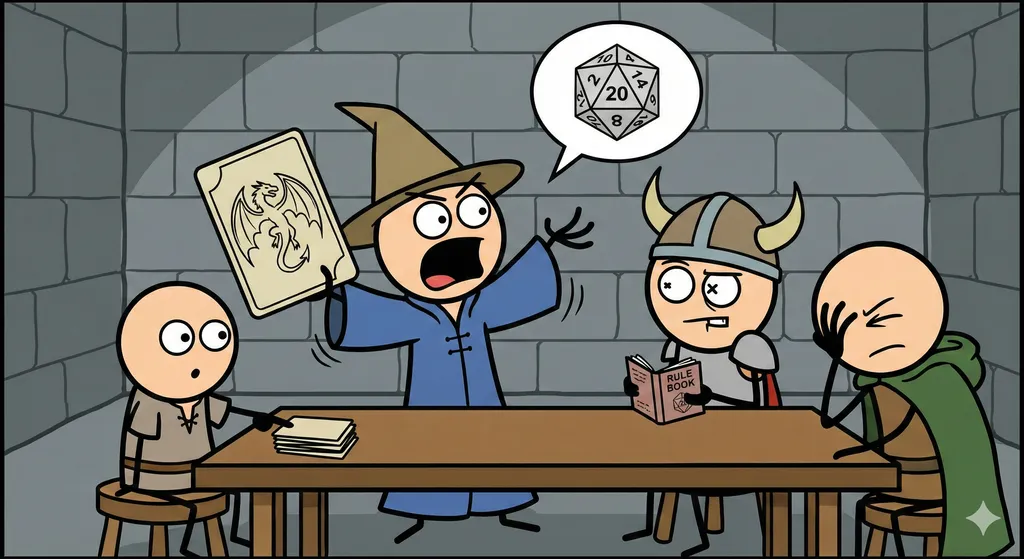
The news broke from EN World like a critical hit: Hasbro, the monolithic publisher behind Dungeons & Dragons and Magic: The Gathering, has officially launched an AI studio, explicitly stating its intent to license its venerable intellectual properties to third parties through this new venture. This isn't just another corporate announcement; it's a tremor beneath the foundational stones of our hobby, demanding a closer look at what it means for the tables we gather around.
Let's strip away the marketing gloss and consider the mechanics of this 'AI studio' and its IP licensing. While the exact operational details remain opaque, the very phrase suggests a pipeline where generative AI tools could assist or even create content based on Hasbro's vast lore. Imagine a third-party developer wanting to craft a new adventure module set in Faerûn. Instead of solely relying on human writers and artists, this studio might offer AI-generated monster stat blocks, NPC dialogue, or even entire dungeon layouts, all 'vetted' against the existing D&D lore database. The 'licensing' aspect likely means developers pay for access to these tools and the right to use the IP, potentially speeding up content creation and lowering initial investment barriers. However, this also implies a standardization, an algorithmic filter applied to creativity. Will these tools provide robust, balanced mechanics, or merely 'good enough' approximations? Will they enhance the designer's vision or homogenize it into a lowest-common-denominator experience? The core question for us GMs and players is whether these mechanically generated elements will feel like organic parts of the game or merely procedurally assembled components. The risk is that the 'crunch' becomes less about elegant design and more about efficient generation, potentially sacrificing depth for volume. For those seeking foundational rules with proven depth, the Dungeons & Dragons Player's Handbook remains a classic.
Beyond the raw mechanics, the implications for lore are profound. Hasbro's IPs—from the intricate planes of Magic: The Gathering to the sprawling Forgotten Realms of D&D—are defined by decades of human creativity, passion, and often, contradiction. Lore isn't just data; it's a living narrative shaped by countless authors, artists, and players. If an AI is tasked with generating new lore, will it uphold the nuanced history and character arcs that define these worlds? Will it understand the subtle cultural distinctions of a Drow city or the political machinations of Ravnica? Or will it merely synthesize existing data, producing bland, derivative content that lacks the spark of genuine imagination? The beauty of these settings often lies in their unexpected corners, the deep cuts of forgotten lore, or the bold new interpretations by passionate creators. An AI, by its very nature, is a pattern-matching engine. It excels at replication, not necessarily at groundbreaking invention or subversive storytelling. The danger here is a 'lore dilution' – a proliferation of content that adheres to established patterns but lacks the soul, the *fluff* that makes these worlds feel alive and worth exploring. We've seen the struggle to maintain consistency with human-generated content; imagine the challenge when an algorithm is added to the mix.
So, is this a boon or a bane for the tabletop? On one hand, it could democratize access to beloved IPs, allowing smaller studios and independent creators to produce licensed content more easily, potentially leading to an explosion of new adventures, supplements, and even full games. More content, faster, and perhaps cheaper. That sounds appealing on paper. However, the veteran GM in me raises an eyebrow. Our hobby thrives on human connection, on shared storytelling, and on the unique, often idiosyncratic, brilliance of individual designers. The 'table feel' isn't just about rules; it's about the magic woven by a GM improvising a compelling NPC, the surprise of a well-placed plot twist, or the sheer joy of a player's creative solution. Will AI-assisted content foster this same organic experience? Or will it lead to a more sterile, predictable play?
The primary concern is quality control and the erosion of creative integrity. If Hasbro's AI studio becomes the gatekeeper and content generator for its IPs, what happens to the distinctive voices that have shaped these worlds? Will we see a deluge of AI-generated adventures that technically adhere to lore but feel utterly generic? Will the unique art styles and narrative quirks that define individual designers be smoothed over by algorithmic averages? This could be a powerful tool for accelerating development, but only if wielded with extreme caution and a deep respect for the human element that built these games. For now, I remain cautiously skeptical. The promise of efficiency often comes at the cost of soul, and the soul of our games is not something to be outsourced to an algorithm.
Top Pick: Shadowdark RPG
Exemplifies robust, streamlined mechanics and evocative lore from a passionate indie designer.
Check Price on Amazon →Related Stories
MTG Arena Devs Unionize: A New Era for Tabletop Labor?
The Magic: The Gathering Arena development team has officially unionized, marking a significant shift in the relationship between creative talent and major publ
Hasbro's AI Studio: A Glimmer or a Glitch for D&D?
Hasbro, owner of Dungeons & Dragons, has launched an AI studio to license its characters. This move ignites a critical discussion on the future of TTRPG content
Prime Day's TTRPG Tides: Navigating the 2026 Sales Surge
Amazon Prime Day 2026 brings a deluge of tabletop deals, and Tabletop Bellhop's curation is a key resource. We break down the strategies for savvy shoppers and