
Initiative: The Unsung Architect of Table Pacing
Gnomecast 240, featuring The Misdirected Mark Podcast crew, delves into the often-overlooked mechanic of initiative in TTRPGs. This deep dive explores how turn order fundamentally shapes pacing, spotlight, and the narrative flow at your table.
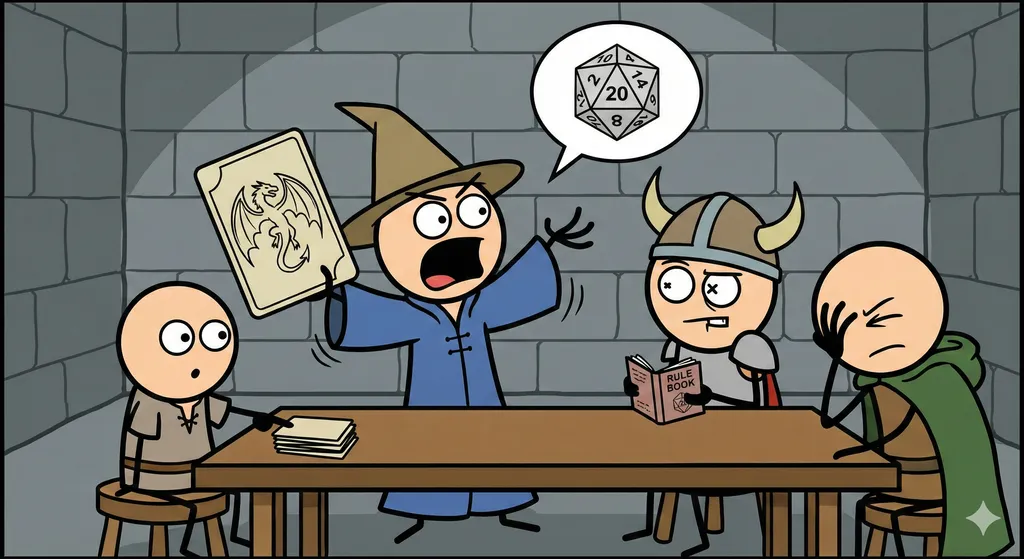
Gnomecast 240, with its special Misdirected Mark Podcast takeover, didn't just discuss initiative; it dissected the very bones of turn order in tabletop RPGs. Bob, Chris, and Phil — seasoned voices in the design space — peeled back the layers of this foundational mechanic, reminding us that how we decide "who goes next" is rarely a neutral choice, but a potent design lever shaping the entire table experience.
From a purely mechanical standpoint, initiative systems are far more varied than many players realize. The ubiquitous "roll a d20, add Dexterity, highest goes first" of Dungeons & Dragons 5th Edition is just one flavor. Its strength lies in its immediate tension and the unpredictable chaos it injects into the start of combat. Every round is a fresh roll of the dice, a moment of uncertainty. Yet, this very randomness can sometimes lead to individual players feeling sidelined if they consistently roll low, or create a sluggish start as multiple rolls are resolved. Contrast this with static initiative, common in older editions or some tactical skirmish games, where characters act in a fixed order based on a stat or pre-determined sequence. This offers predictability and allows for more intricate tactical planning, but can also feel less dynamic.
Then there's the delightful chaos of Popcorn Initiative, exemplified in games like Lancer or some FATE derivatives. Here, the active player decides who goes next, passing the "initiative spotlight" around the table. This system brilliantly encourages player agency, ensures everyone gets a turn, and can create incredibly dynamic, player-driven action sequences. On the other end of the spectrum, many Old School Renaissance (OSR) games, like Shadowdark RPG, favor side-based initiative, where an entire faction (players or monsters) acts before the other. This abstracts combat, speeds up play, and shifts the focus from individual actions to broader tactical considerations, often emphasizing the lethality and danger of the encounter.
The "lore" of initiative isn't found in a dusty tome, but in the very narrative it helps to weave. A chaotic, roll-and-go system tells a story of an unpredictable world, where even the most valiant hero can be caught flat-footed. It reinforces a narrative of constant danger and the fog of war. Static initiative, conversely, might imply a more ordered, perhaps even fated, sequence of events, where character prowess reliably dictates their readiness. Popcorn initiative, by its nature, fosters a collaborative narrative, where the heroes actively dictate the flow of the battle, highlighting their unity and tactical prowess as a team. Side-based initiative, on the other hand, speaks to a grander scale, where groups clash, and the focus is on the ebb and flow of the greater conflict, rather than individual heroics. The system chosen reinforces the GM's intended tone and the game's core themes, whether that's gritty realism, heroic fantasy, or tactical sci-fi.
So, what's the verdict for your table? There is no single "best" initiative system; only the one that best serves your game, your group, and your campaign's narrative. For a GM, understanding these nuances is paramount. A system that emphasizes player agency might reduce your cognitive load, while one focused on tracking individual turns could increase it. Pacing is profoundly affected: a quick, narrative initiative can keep the action flowing, while a complex, turn-based system might slow things down but reward meticulous tactical play. Critically, consider how each system manages the spotlight. Does it ensure every player feels engaged and gets their moment to shine, or does it leave some feeling like they're always waiting for their turn? Experimentation is key. Don't be afraid to try different approaches or even house-rule a hybrid that perfectly fits your group's desired table feel.
Top Pick: The Lazy DM's Workbook
For streamlined GM prep and encounter design that pairs well with any initiative system.
Check Price on Amazon →Related Stories
Unlocking the Score: Beyond Player Assumptions in Blades in the Dark
Gnome Stew's latest insight on GMing Blades in the Dark reveals a common player pitfall: self-limiting ideas. We dissect how veteran GMs can subtly shift player
Beyond Tropes: Perfecting Genre Detail at Your TTRPG Table
Gnomecast 239 from Gnome Stew explores the crucial, often-overlooked details that define a TTRPG genre. We dissect how these granular elements transform broad s
Aethelgard's Resonance: Power, Peril, and Player Division
Arcane Forge Studios' Chronicles of Aethelgard: Sundered Isles Edition introduces the Resonance System. This innovative mechanic promises deep character immersi