
Parallax Wave: The Unintended Engine That Breaks Systems
We dissect a notorious Magic: The Gathering interaction to uncover deep lessons for TTRPG system design. Learn how simple rules combine for unforeseen power, impacting your table.
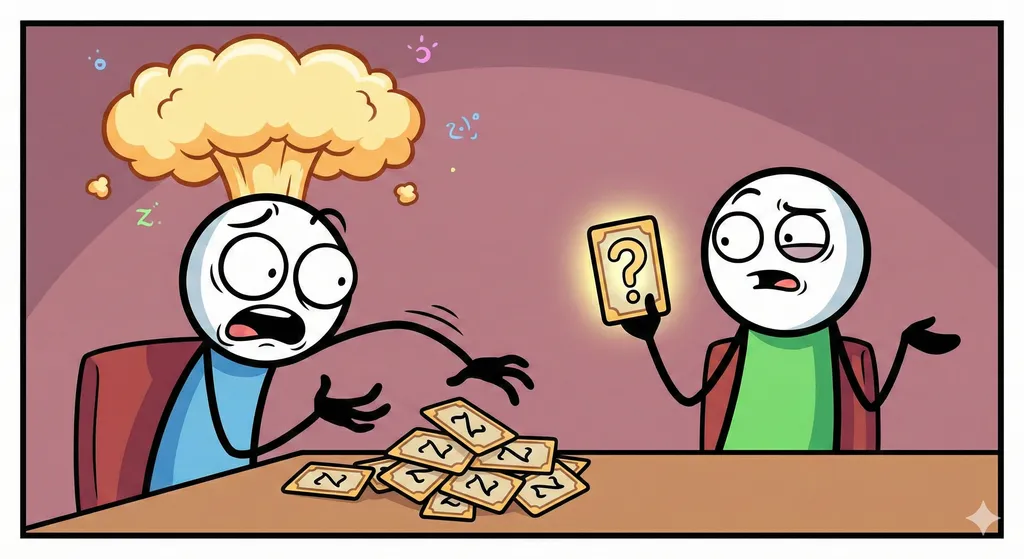
The recent buzz around *Magic: The Gathering*'s notorious Parallax Wave and its publisher, Wizards of the Coast, isn't about a new set or a Universes Beyond crossover. Instead, it's a deep dive into the kind of emergent gameplay that veterans of any system—from *D&D 5th Edition* to *Pathfinder*—know all too well: the seemingly innocuous card or ability that, with one clever trick, becomes an almost unbeatable engine. This isn't just about TCGs; it's a fundamental lesson in system design, player agency, and Game Mastering that demands our attention.
For those unfamiliar with the specific arcane geometry of *Parallax Wave*, it's an enchantment that enters the battlefield with five fade counters. You can remove a counter to exile a target creature until Parallax Wave leaves the battlefield. The 'trick' lies in using an effect that removes Parallax Wave from play *in response* to its own 'leaves the battlefield' trigger. By removing the Wave from play while its 'leaves the battlefield' ability is still on the stack, the creatures it exiled are never returned, as the ability that *would* return them resolves before the effect that removes the Wave. This creates a loop where, with proper timing and a repeatable way to remove the Wave, you can effectively exile any number of creatures permanently. It's a classic example of state-based actions and timing windows creating an infinite loop from simple components, transforming a utility card into a game-ending threat.
Now, before you dismiss this as just TCG minutiae, consider the parallels at your own table. How many times has a player discovered an unexpected synergy between a *D&D* spell like *Animate Objects* and *Wall of Force*, or a *Pathfinder* feat chain that trivializes combat encounters? These aren't always malicious exploits; often, they're the result of players engaging with the ruleset at a deeper level than the designers anticipated. A clever *Shadowdark* player might find an interaction between a specific item and a class ability that grants near-invincibility, or a *Cyberpunk RED* techie might combine components in a way that generates infinite credits. These emergent strategies are the TTRPG equivalent of a *Parallax Wave* loop. The challenge for the Game Master, then, is not to simply ban the interaction, but to understand *why* it works and *what it says* about the underlying system. Is it a bug, or an elegant feature of robust rules?
In the lore of *Magic: The Gathering*, cards like *Parallax Wave* evoke a sense of temporal distortion or reality manipulation. Its art depicts a swirling vortex, a visual metaphor for the disruption it causes on the battlefield. It fits the abstract, often cosmic, nature of *Magic*'s planes, where the very fabric of reality can be bent by powerful spellcasters. It's not a creature, but a force, and its mechanical interaction reflects that ability to bend the rules of engagement, twisting the flow of time and space to its caster's will.
For TTRPGs, these mechanical exploits often clash with the narrative. Does an infinite gold loop make sense in the gritty reality of *Cyberpunk RED*? Does a truly unbeatable combat combo align with the desperate struggle against eldritch horrors in an *OSR* dungeon? The disconnect between 'crunch' and 'fluff' can be jarring. A truly immersive world needs its mechanics to feel like an extension of its reality, not a separate game of numbers. When players discover such a powerful loop, the GM must decide: is this a 'secret technique' within the world, a forgotten piece of ancient magic, or simply a meta-game exploit that needs addressing? The best solutions often involve weaving the mechanics into the narrative fabric, giving the players a lore-appropriate explanation for their newfound power, or a consequence for its abuse, thus maintaining immersion.
So, is the existence of 'Parallax Wave'-esque interactions good for our TTRPGs? It's a double-edged sword. On one hand, the thrill of discovering such a potent synergy is a core part of player agency and creativity. It rewards deep system knowledge and clever thinking. It can lead to memorable moments where a party overcomes an impossible challenge through sheer ingenuity, rather than brute force or GM fiat. It fosters community discussion, theorycrafting, and shared discovery – much like how the *Magic: The Gathering* community dissects every new set for potential combos. This kind of interaction pushes the boundaries of a game, revealing its true flexibility.
On the other hand, an 'unbeatable engine' can quickly drain the fun from a campaign. If every combat becomes a predictable sequence of actions leading to an instantaneous win, the challenge evaporates. GM preparation becomes futile, and other players at the table might feel marginalized if one character's combo dominates every scene. It can lead to a 'solved game' mentality, where exploration and roleplaying take a backseat to optimizing the loop. For Game Masters, it presents a significant challenge: adapt the encounters, introduce new threats that bypass the combo, or have an honest conversation with the players about table enjoyment. Ultimately, the goal isn't to eliminate emergent gameplay, but to manage it. A good designer, whether professional or a homebrew GM, anticipates these interactions and decides whether they enhance or detract from the overall experience. Sometimes, a powerful combo is a feature, a reward for clever play. Other times, it's a bug that needs an errata or a narrative intervention. The lessons from *Parallax Wave* are clear: simple rules can lead to complex, powerful, and sometimes disruptive outcomes. Understanding these dynamics is crucial for anyone building worlds, writing adventures, or simply running a satisfying game at the table.
Top Pick: Monster of the Week
Its PbtA framework encourages narrative adaptation, making it incredibly resilient and responsive to unexpected player tactics and combos.
Check Price on Amazon →Related Stories
The Unsung Architects: What Family Board Games Teach TTRPG Design
Board Game Quest's 'Top 10 Family Board Games' highlights elegant design principles. TTRPGs can leverage these for accessibility and depth, proving simplicity i
Maro's Secret Project: Mood Swings & The Art of Simplicity
Mark Rosewater, Magic: The Gathering's head designer, unveils Mood Swings, a TCG honed for 28 years. This deep dive explores its mechanics, lore, and potential
WotC's Union Stance: A Critical Look at Arena's Future
Wizards of the Coast faces a unionization petition from its MTG Arena team. Their response, hiring a known union-busting firm, raises serious questions about co