
Shadowdark's 'Defending Out of the Fun' Philosophy
Kelsey Dionne's insight into player agency offers a potent GMing philosophy for Shadowdark and beyond. We dissect how to foster daring play without railroading, enhancing narrative and table engagement.
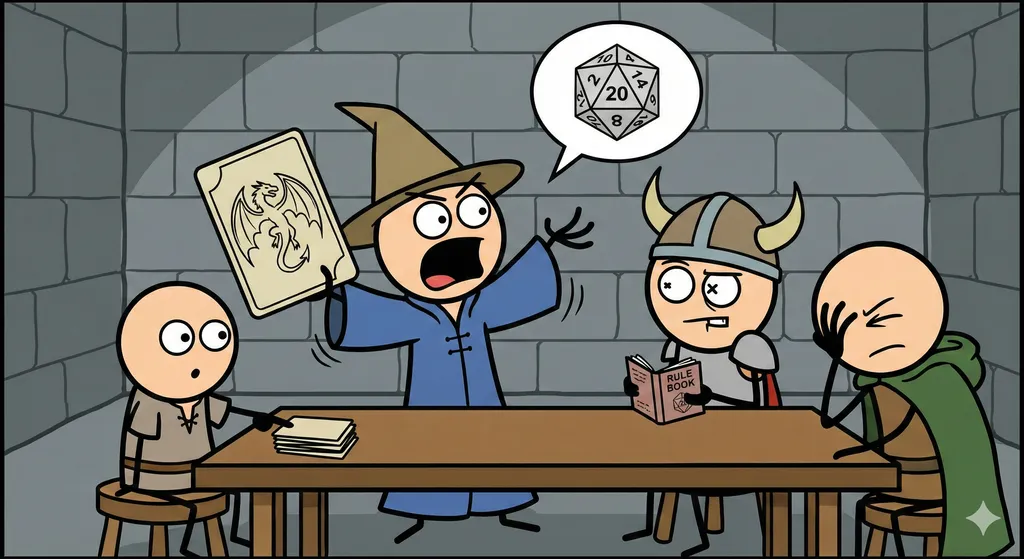
The creator of Shadowdark, Kelsey Dionne of Arcane Library, recently illuminated a concept on the Dungeon Master Diaries podcast that, for veteran Game Masters, resonates deeply: the idea of players "defending out of the fun." This isn't about GMs denying player agency; it's about recognizing when a player, through overly cautious, meta-gamey, or hyper-optimized choices, inadvertently walls themselves off from the most exciting, narrative-rich, and memorable moments the game has to offer.
At its core, “defending out of the fun” manifests when a player prioritizes absolute safety or mechanical optimization to such a degree that they avoid engaging with the very challenges designed to make the game compelling. Think of the rogue who meticulously checks every single pixel of a dungeon hall for traps, even after the initial sweep, grinding the pace to a halt while a monstrous threat looms. Or the wizard who exclusively uses low-impact utility spells to avoid depleting higher-level slots, even when a dramatic, impactful spell could turn the tide. These actions, while often logical within the confines of a strict ruleset, can inadvertently stifle the emergent narrative, the heroic risks, and the thrilling consequences that define great TTRPG sessions.
Shadowdark’s ruleset, with its OSR sensibilities, inherently pushes against this defensive playstyle. Its unforgiving monster design, brutal critical hit tables, and the pervasive threat of darkness and resource scarcity force players to make difficult, often risky, decisions. There's less room for exhaustive optimization when survival itself is a constant struggle. Light sources burn out, magic items are scarce and often cursed, and every encounter carries genuine peril. This mechanical pressure encourages players to embrace the unknown, to take calculated gambles, and to react dynamically rather than over-analyze. A GM running Shadowdark RPG Core Rules is, by the very design of the game, empowered to present a world where such defensive postures are often untenable or, at best, lead to a slow, methodical grind rather than a heroic saga.
The philosophy of "defending out of the fun" profoundly impacts how we engage with game lore and worldbuilding. When players are encouraged (or mechanically compelled) to take risks, to explore dangerous locales, and to interact with the world beyond mere statistical advantage, they uncover lore organically. The ancient ruins aren't just a collection of traps and monsters to be bypassed; they become a site of forgotten rituals and desperate last stands. The enigmatic NPC isn't just a quest-giver; they're a potential ally, rival, or source of dangerous secrets. This approach transforms lore from static exposition into a dynamic, player-discovered narrative, making the world feel more alive, mysterious, and responsive to the characters' daring actions. The very act of taking a risk to interact with a strange artifact, rather than simply identifying it from a distance, can unlock entire narrative arcs and deepen player investment in the setting.
Is this philosophy good for the game? Absolutely, when wielded with a sensitive hand. It's not about railroading players or punishing caution; it’s about recognizing the subtle cues that indicate a player is sacrificing potential fun for perceived safety. A GM, armed with this awareness, can gently reframe situations, introduce time pressure, or present choices that make the more engaging option also feel like the most compelling. It demands a GM who is present, observant, and willing to nudge the narrative towards excitement without stripping players of their agency. The goal is to cultivate a table where players *want* to leap into the fray, where they embrace the narrative consequences of their choices, and where the thrill of the unknown outweighs the comfort of the perfectly optimized decision. This leads to more memorable sessions, richer character arcs, and a tabletop experience brimming with genuine adventure.
Top Pick: The Monsters Know What They're Doing by Keith Ammann
Deepens tactical GM understanding, complementing this player-centric approach.
Check Price on Amazon →Related Stories
Tactical Sketching: Why Small Maps Elevate TTRPGs
The Crit Sheet investigates the growing trend of 'Tactical Sketching,' a map philosophy championed by games like Threshold & Torchlight. We break down how drawi
Beyond Genres: Tagging TTRPGs for Clarity and Discovery
Sly Flourish's discussion on 'Defining RPGs with Tags' offers a vital framework for categorizing TTRPGs. This deep dive explores how a precise tagging system ca
Echoes of the Hearth: The Quiet Revolution of Tabletop
Arboreal Games' Echoes of the Hearth offers a narrative-driven respite from high-stakes combat, focusing on community and shared storytelling. This indie TTRPG