
Slaying Quantum Ogres: Flexible Prep, Real Player Agency
The dreaded 'Quantum Ogre' threatens player agency by moving encounters. Sly Flourish's 'Eight Steps' offers a robust methodology to build dynamic, responsive campaigns without railroading.
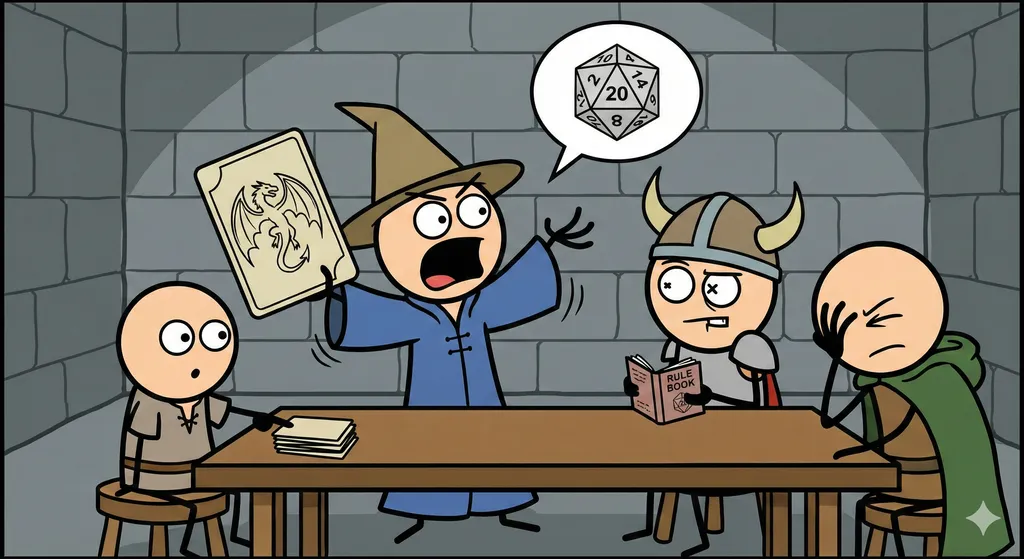
Every Game Master, at some point, has felt the cold dread of a meticulously planned encounter left untouched because players chose the unexpected path. This common pitfall, known colloquially as the “Quantum Ogre,” posits that if players bypass a specific monster or challenge, the GM simply moves that challenge to the next path the players take, thereby nullifying their agency. It’s a design anti-pattern that many veteran GMs have wrestled with, and it’s precisely what Sly Flourish’s seminal work on game mastering, “Quantum Ogres and the Eight Steps,” comprehensively addresses.
At its core, the Quantum Ogre isn't about the monster itself, but the GM’s attachment to a specific *outcome* rather than preparing *elements*. Flourish’s methodology, detailed in the The Lazy Dungeon Master, provides a surgical approach to disassembling the rigid structure that births such ogres. The “Eight Steps” aren't a linear checklist but a suite of modular prep tools designed for adaptability. Rather than prepping “the ogre in the cave,” a GM prepares “an ogre” and “a cave,” along with other threats and locations, ready to be deployed organically. Steps like “Choose Relevant Monsters” and “Detail Fantastic Locations” shift focus from pre-scripted encounters to preparing *assets*. If the players avoid the ogre’s traditional lair, that ogre—or a similar threat—can emerge from another fantastic location they *do* explore, but only if it makes narrative sense and isn't simply teleported. The crucial distinction is that the *elements* are prepared, not their fixed position or specific trigger. This allows for genuine reactivity, where player choices truly matter, and the world feels alive, not merely a stage for the GM’s pre-written script.
From a lore perspective, the Eight Steps foster a more believable and immersive world. When encounters and discoveries aren't predetermined by player path, the world gains a sense of persistent reality. The “Develop Secrets and Clues” step is particularly potent here. Instead of scattering specific clues at fixed points, the GM preps a handful of key secrets and clues that can be discovered through various means, in different locations, or from different NPCs. This means that whether players investigate the dusty library, interrogate a captured bandit, or decipher an ancient rune, they can still uncover vital pieces of the overarching narrative. The lore isn't a breadcrumb trail; it’s a rich tapestry woven throughout the setting, discoverable through genuine exploration and interaction. This approach deeply enriches the player experience, making the campaign’s lore feel less like exposition and more like history they actively uncover.
The verdict on the table feel is unequivocally positive. This approach, applicable to D&D 5th Edition, Pathfinder, or any TTRPG, liberates both GM and players. For the GM, it drastically reduces prep time and the stress of anticipating every player decision, replacing it with the confidence of having versatile components ready to hand. For players, it cultivates unparalleled agency. Their choices echo meaningfully through the campaign, as the world genuinely reacts to their actions, not merely redirects them. The fear of being railroaded dissipates when the GM is empowered to react fluidly, making the world feel dynamic and responsive. It transforms the GM from a frustrated director to an agile facilitator, ensuring that every session feels like a unique, player-driven narrative. This is not just good for the game; it’s essential for fostering truly engaging, long-term campaigns.
Top Pick: Return of the Lazy Dungeon Master
Essential reading for GMs seeking flexible, player-centric prep methods.
Check Price on Amazon →Related Stories
The Narrative Power of Non-Mechanical Outcomes
Sly Flourish challenges GMs to embrace fictional outcomes over strict mechanics for every roll. This approach enriches TTRPGs, fostering deeper immersion and mo
The Modular 5e: Crafting Your Perfect Tabletop Engine
Sly Flourish's observations on 'House Rules from Various 5es' highlight 5th Edition's unexpected strength: its modularity. We dissect how veteran Game Masters l
The Blueprint of Play: Deconstructing TTRPG Adventure Types
Understanding distinct adventure types is a fundamental skill for any Game Master. We dissect how different structures impact mechanics, lore, and the overall t